Executive Summary
October took back most of September’s selloff, and Treasuries posted their biggest monthly gain in more than two years. Between our last update on October 5 and Friday’s close, yields fell 28–39 bp from the 2-year out. The 10-year closed at 4.94% and is trading near 4.88% this morning, and the 2-year is at 4.56%. Early in the month the 10-year traded as high as 5.35% intraday on October 7, its highest level since 2002, before reversing.
Two different forces drove the rally. At the front end, a 29K September payroll print and a softer PCE reading took an October hike off the table, and the Fed held at 3.75–4.00% on October 28. At the long end, Treasuries caught a flight-to-quality bid on October 22, when an AI-led equity selloff hit at the same time as an oil spike, and the 10-year fell 17 bp in a single session. The economy itself hasn’t cracked: Q3 GDP grew 3.4%.
The theme to watch now is the hyperscalers. AI capital spending is carrying a large share of US growth, and more and more of it is funded with debt. That creates risk in both directions for rates. If AI spending wobbles, Treasury yields fall and credit spreads widen. If it keeps going, growth and inflation stay hot enough for the Fed to keep hiking.
For borrowers, the practical effects:
- Lower base rates; spreads mostly steady. Treasuries rallied, and CMBS spreads outside data centers held near year-end levels, so most borrowers saw the full benefit. Data center loans are the exception: AAA spreads are 60 bp wider this year.
- Higher defeasance costs. A ~35 bp drop in the 5- to 7-year sector adds roughly 1.5 points of loan balance to a defeasance with five years remaining. Re-run any estimate from early October.
- Cheaper caps. Cap premiums have come down with the rally, and extensions cost less than they did in early October.
- The Fed is still tightening. Futures price a 75% chance of a December hike and about two hikes by the end of 2027, peaking near 4.45%. That’s in line with our desk’s baseline of December plus an insurance hike early next year, taking SOFR to about 4.40%.
Our guidance: use the rally to add fixed-rate protection in small pieces, get cap extensions done while premiums are lower, compare collars with caps, and re-price any pending defeasance.
Treasury Curve: October 5 to October 30
Every maturity fell. Bills barely moved, with the 3-month down 6 bp, while the 2- to 30-year sector dropped 28 to 39 bp, led by the 7-year.
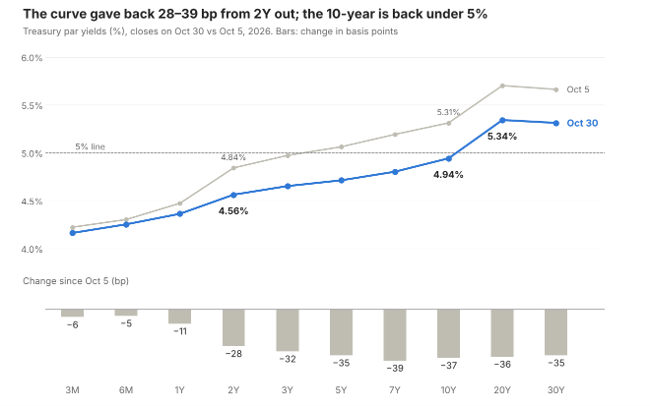
U.S. Treasury daily par yield curve, closes 10/5/2026 and 10/30/2026. The 11/2 curve was not yet published at writing.
The long end is off its highs but still elevated. The 20- and 30-year remain above 5.3%, and the 10-year is about 77 bp higher than a year ago. The front of the bill curve held because the market still expects the next Fed move to be a hike, not a cut.
What Drove the Move
Fed repricing moved the front end, a flight to quality moved the long end, and oil pushed in both directions over the month.
- The Fed. The FOMC held on October 28 in a 10–2 vote. Governor Cook and Cleveland’s Hammack dissented in favor of another 25 bp hike. The statement upgraded growth from “solid” to “strong,” and Chair Warsh argued that tighter financial conditions are doing some of the Fed’s work: higher borrowing costs, wider credit spreads, and investors becoming more selective about what they finance around AI. Fed funds futures price a 75% chance of a December hike and about 2.3 hikes at the September 2027 peak, an implied overnight rate near 4.45%. By the end of 2027 that eases to about two hikes. Before the FOMC, futures priced nearly three hikes and a 4.62% peak, so the October rally took almost a full hike out of the path.
- Growth strong, hiring weak. Q3 GDP grew 3.4% annualized against 3.1% expected, driven by investment. September payrolls were only 29K, unemployment rose to 4.2%, wage growth slowed to 3.0% (the weakest since May 2021), and July and August were revised down a combined 60K. Unemployment is holding up mostly because labor supply growth has slowed.
- Inflation. September CPI rose 0.6% on the month and 3.7% year over year, up from 3.4%, with gasoline driving the jump. Core CPI was a calmer 2.6%. PCE came in at 3.6% year over year against 3.7% expected, and the 2-year fell more than 10 bp on the print.
- Oil. Attacks on Saudi Arabia pushed Brent to nearly $117 on October 22–23, its highest since April. This morning it fell about 8% to roughly $104 on reports that Iran approved talks, and 10- to 30-year yields dropped another 4–6 bp to their lowest since September. Oil still matters, but it’s no longer the only driver. Our desk notes the 10-year now tracks the Nasdaq more closely than oil.
- Flight to quality. On October 22 the semiconductor index fell 6.7%, Brent jumped, and the 10-year dropped 17 bp to 4.96%, Treasuries’ best day in more than two years per Bloomberg. Real-money buyers also stepped in once yields cleared 5%. Deutsche Bank’s rates team notes that the traditional negative correlation between bonds and equities has returned over the past month, which means Treasuries are once again working as a hedge against an equity selloff.
- Supply. Treasury’s upsized long-end buybacks (up to $6 billion per operation in 10- to 20-year debt) helped at the margin. The FY2026 deficit came in at $1.99 trillion.
The Hyperscaler Story
AI spending is now a rates and credit story as much as an equity story.
- The spending. Amazon expects about $220 billion of 2026 capex. Alphabet held at $195–205 billion. Microsoft trimmed its calendar-2026 forecast to $170 billion because of GPU delivery delays, but it expects spending to accelerate in the first half of 2027. Meta raised its range to $135–145 billion, and S&P projects more than $225 billion for Meta in 2027.
- Cash flow has turned negative. Meta’s Q3 free cash flow was −$2.1 billion. Alphabet’s was negative by more than $9 billion in Q3. Amazon’s trailing-12-month free cash flow is −$42.4 billion.
- So they’re borrowing. Five hyperscalers had issued $218 billion of investment-grade bonds by early October, about double their full-year 2025 total of $107 billion. Meta raised $37.5 billion of equity and plans a $60 billion at-the-market program starting in January, and on October 30 S&P moved Meta’s AA- outlook to negative. Five-year CDS ranges from 56 bp at Microsoft and 80 bp at Amazon to 331 bp at Oracle.
- The market is pushing back. Per our desk, the Nasdaq 100 fell 6.7% in October, erasing about $2.7 trillion of value, and the semiconductor index closed below its 200-day moving average for the first time since June 2025. Global corporate spreads widened to 129 bp on October 23, the widest since May 2025.
- Private AI labs are raising too. In an SEC filing today, Anthropic disclosed nearly $17 billion of Q3 revenue (up from $1.4 billion a year earlier) and more than $895 billion of planned spending in the years ahead. Its IPO is set for before Thanksgiving and reportedly aims to match or beat SpaceX’s $86.2 billion debut. That would be a direct test of how much capital investors will commit to AI.
- The economy leans on it. Our desk highlighted Kathryn Rooney Vera’s point that AI investment is roughly 3% of GDP but drove 67% of Q1 growth and 44% of Q2. Strip it out and first-half growth was under 1%.
Why this matters for CRE borrowers:
- Rate risk runs both ways. An AI pullback means lower Treasury yields, cheaper fixed-rate hedges and more expensive defeasance. Continued spending means stronger growth, stickier inflation and more Fed hikes. Neither outcome looks like a slow, gradual move.
- Spreads may not follow Treasuries. Hyperscaler bonds compete with every other investment-grade and CMBS issuer for the same buyers. When Treasuries rally on AI fear, all-in borrowing costs fall less than the headline 10-year suggests.
- Data centers are repricing. Per Trepp, fixed-rate AAA data center CMBS widened 21 bp to 182 bp over Treasuries in the week of October 23 and are 60 bp wider year to date. Single-A data center bonds are 105 bp wider, while other single-asset CMBS sit within 3 bp of year-end. Every underlying loan is current, so investors are repricing the sector, not the collateral.
Desk Commentary
Hedging and Derivatives
Our hedging desk’s message: the market is already pricing something close to the worst case, so take small bites on rallies and favor structures that keep some upside.
- Fed baseline. The desk expects a December hike, then an insurance hike early next year at a pace of every other meeting. That would put SOFR around 4.40%, close to the roughly 4.45% peak that futures imply. The risk is that the Fed does more, or moves faster.
- Fixed rates already price a lot of tightening. With swap rates still above 4.50%, borrowers locking today are paying for a scenario close to the desk’s worst case.
- Collars. One structure the desk likes is a 3.90% floor (roughly today’s SOFR) with protection starting at 4.50%. The borrower gets protection above that level without locking in a fixed rate today.
- Caps are cheaper after the rally. Premiums have eased from early-October levels, and cap extensions now cost less than they did a month ago. Borrowers with extensions coming up should price them now rather than wait for the next spike.
- Cancelable swaps. For borrowers who think rates have already peaked, a cancelable swap is still a strong option. It fixes the rate today and keeps the right to exit without a large termination cost if rates fall.
- The wildcard is geopolitics after the midterms. Renewed escalation would lift energy costs, extend inflation pressure and strengthen the case for more hikes.
Defeasance
Volume is picking up into year-end, but the rally has raised costs.
- Year-end push. Transaction volume is rising as borrowers push to close before year-end, led by property sales. The product mix is standard, with multifamily and retail still the most active.
- Costs are up. As an illustration, a loan with five years remaining defeased with a portfolio of about 4.5 years’ duration loses roughly 1.5–1.6 points for every 35 bp drop in yields. That’s about $300K more per $20 million of balance than at early-October levels. Last month’s tailwind from high yields has reversed.
- Re-quote early-October estimates. Borrowers who priced around the October 7 highs caught the cheapest securities in decades and should expect a meaningfully higher number now.
- Agency securities are helping. Agency bonds and bullets are becoming more available, which is lowering portfolio costs for borrowers. Supply is still somewhat limited, so availability varies by deal.
Lending and Commercial Real Estate
The rally has eased financing conditions a bit. Last month most deals capped out at 60–65% LTV and CMBS executions needed 2–3 points of rate buy-down. Lower base rates have loosened both somewhat, and more deals are passing coverage and proceeds tests. Conditions are still tighter than they were this summer, so borrowers should still close on time and not count on rate-lock extensions.
- Watch spreads, not just Treasuries. The October rally lowered base rates, but wider credit spreads, especially in data center and lower-rated CMBS, offset part of the gain.
What to Watch in November
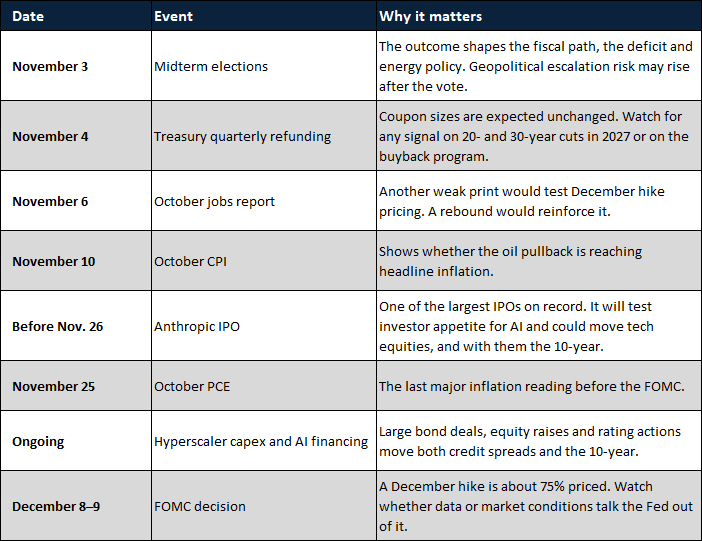
The month turns on whether the AI trade and the election push yields lower, or whether jobs and inflation data push the Fed toward more hikes.
Client Takeaways
- Fixed-rate hedges: use rallies like October’s to add protection in small pieces rather than waiting for a perfect entry.
- Cap extensions: execute now while premiums are lower after the rally.
- Floating-rate borrowers: price a collar or a cancelable swap alongside a cap. Both keep more upside than a standard swap.
- Defeasance: re-run any estimate from early October. Costs are up roughly 1.5 points of balance for a loan with five years remaining.
- New financing: focus on spreads as well as Treasuries, especially for data center and lower-rated execution.
- Event risk: expect volatility around the election, the refunding, the first-week data (November 3–10) and the Anthropic IPO.
Data Notes and Sources
- Curve levels are from the U.S. Treasury daily par yield curve for 10/5/2026 and 10/30/2026. The 11/2 curve was not published when this was written; this morning’s 10-year level (about 4.88%) is from Trading Economics.
- Bloomberg: Treasury market story by Elizabeth Stanton and “Anthropic Commits to $895 Billion in Spending as Mega-IPO Nears” (Bailey Lipschultz), November 2, 2026.
- The defeasance illustration assumes a level-payment portfolio of about 4.5 years’ duration and a parallel 35 bp move. Actual sensitivity depends on the payment schedule, maturity, amortization and securities selection.
- Desk views are from the hedging desk’s October 28 note, the November 2 market note and our October 30 prep call.
- Market data: S. Treasury par yield curve; Trading Economics, US 10-year; Trading Economics, Brent; CNBC, October FOMC; CNBC, October 22 Treasury rally; NAW, Q3 GDP; SimianX, September CPI; Silicon Report, Microsoft and Alphabet capex; Constellation Research, Amazon Q3; PPC Land, S&P on Meta; TokenPost, hyperscaler issuance and CDS; MarketScale, credit spreads; WRE News, Trepp data center CMBS; Reuters via 93.3 The Drive, refunding preview.
This update is market commentary, not investment, legal or tax advice.
Luke Fuller, Director
 Luke Fuller is the Director of Capital Markets at Defease With Ease | Thirty Capital, bringing 10+ years of experience in debt structuring, interest rate risk management, and capital markets execution for CRE investors. With expertise in securitization, derivative hedging strategies, and structured finance, he focuses on optimizing debt portfolios and mitigating market risk through advanced financial modeling and analytics. Luke has extensive experience in CMBS, agency, and balance sheet lending, structuring financial instruments, and executing transactions across multiple asset classes. He has advised investors, private equity firms, and REITs on interest rate derivatives, yield curve analysis, loan restructuring, and portfolio risk assessment.