The Fed held at 3.75% last Wednesday on a 9–3 vote, but this wasn’t the end of the hike debate, it was a seven-week postponement. Three regional Fed presidents dissented in favor of hiking now, markets still price roughly a 63% chance of a hike on September 16 (down from 68% Friday after the latest Middle East de-escalation), and Chair Warsh made clear the soft June CPI bought time, not an all-clear. Long-end yields hit their highest levels since 2007, the curve steepened dramatically over the past month, and we expect it to keep steepening. Our advice for borrowers hasn’t changed, and we’d be very cautious going into this market unhedged: keep hedges short and in the belly of the curve (5–7 years), buy the dips, and get caps and forward extensions in place now. A 25bp September hike is the base case if inflation data rebounds, and a 50bp catch-up move is a tail risk worth planning for.
What Happened
- Held, but hawkishly. The 9–3 vote saw Hammack (Cleveland), Kashkari (Minneapolis), and Logan (Dallas) all prefer to hike immediately. No governor joined them… yet.
- The market did the Fed’s work. Warsh said June’s mild inflation report affected the decision “not much.” Instead, he pointed to the rise in Treasury and swap rates since June — tighter financial conditions “provided us some comfort.” In plain English: yields rose enough that the Fed didn’t have to act.
- The long end isn’t buying it. Warsh declared “this Fed will not waver” on price stability — and 30-year yields promptly jumped to their highest level since 2007 (above 5.20%). The market heard the promise; it doesn’t fully believe it.
- The move in one month: 2Y +12bps to 4.26%, 5Y +18bps to 4.41%, 10Y +21bps to 4.69%, 30Y +25bps to 5.23%. A textbook bear steepener — the further out the curve, the bigger the move. The 2s10s spread tells the story in one picture: roughly 31bps just before the July 29 FOMC, 45bps within 48 hours of the press conference — that jump was the market’s verdict on Warsh — and it sits near 43bps today. The short end is anchored to Fed policy; the 10- and 30-year are trading on inflation credibility, and 2-year swaps are still north of 4% against a 3.65% SOFR.
- Inflation is still the problem. CPI is running 3.5% y/y and core PCE came in at 3.3% last week — a 3-handle that isn’t coming down, with oil and supply shocks adding pressure. That’s the number keeping the long end nervous.
![U.S. Treasury yield curve, 8/3/26 (green) vs. 7/1/26 (red) — 12–25bps higher across the curve in one month, with the biggest moves at the long end. [Source: Tradeweb]](https://www.defeasewitheasetc.com/wp-content/uploads/2026/08/Market-Update-August-3-2026-1.png)
U.S. Treasury yield curve, 8/3/26 (green) vs. 7/1/26 (red) — 12–25bps higher across the curve in one month, with the biggest moves at the long end. [Source: Tradeweb]
![2s10s Treasury spread (USYC2Y10), past month — the curve jumped from ~31bps to ~45bps on the July 29 FOMC and Warsh’s press conference; ~43bps today. [Source: Bloomberg]](https://www.defeasewitheasetc.com/wp-content/uploads/2026/08/Market-Update-August-3-2026-2-1024x529.png)
2s10s Treasury spread (USYC2Y10), past month — the curve jumped from ~31bps to ~45bps on the July 29 FOMC and Warsh’s press conference; ~43bps today. [Source: Bloomberg]
What Markets Are Pricing
Fed funds futures priced a 67.8% probability of a September 16 hike at Friday’s close; that eased to 63% Monday morning on the Iran de-escalation and the coordinated US–Japan yen intervention. A word of caution on chasing that move: this is the second Monday in a row rates have softened on Middle East de-escalation headlines, only to climb back during the week. A full 25bp hike isn’t completely priced until December, with the implied policy rate grinding to roughly 4.13% by mid-2027. Note what’s not priced: a 50bp move. Warsh explicitly said the Fed won’t be constrained by market expectations — and with forward guidance deliberately pulled, expect more rate volatility, not less, into the meeting.
![World Interest Rate Probabilities (Bloomberg, priced 8/3/26) — 63% hike odds for 9/16; implied rate peaks ~4.13% in mid-2027. [Source: Bloomberg]](https://www.defeasewitheasetc.com/wp-content/uploads/2026/08/Market-Update-August-3-2026-3.png)
World Interest Rate Probabilities (Bloomberg, priced 8/3/26) — 63% hike odds for 9/16; implied rate peaks ~4.13% in mid-2027. [Source: Bloomberg]
Our Recommended Strategy
- Stay short on the curve. With the curve steepening and term premium building, keep fixed-rate hedges in the belly — the 5- to 7-year tenor — rather than paying up for 10+ years. Even on 10-year loan commitments, banks are offering flexibility on hedge tenor; use it. The Treasury supply picture argues the same way: roughly $8 trillion of government debt needs to roll, and a steeper curve makes that financing harder — structural upward pressure on the long end that isn’t going away.
- Buy the dip — including today’s. Rates are marching higher in an upward-trending range, and it’s been a winning strategy for six months: use pullbacks to execute. 2- through 5-year fixed rates are essentially equal right now — take your pick. Monday morning headline rallies like this one have been fading by mid-week; treat them as execution windows, not turning points.
- Caps: get them in now. Put rate cap extensions in place on a forward basis and keep them short-dated to maintain flexibility. Waiting for a September hike to be confirmed means paying more for the same protection.
- Don’t ride this market unhedged. The Fed has deliberately pulled forward guidance — higher volatility is the design, not the accident — and policy can move through more than the funds rate (the balance sheet is a live tool). A 50bp September move is not our base case, but it belongs in every borrower’s risk planning. What matters most is having any risk-management strategy in place rather than none.
What We’re Seeing on the Ground
Deal flow is steady but choppy: multifamily continues to lead with retail behind, and we’re seeing more sales than refinances across the same mix of bank, CMBS, and agency executions. Closing timelines remain volatile, and last month a handful of trades fell through on buyer financing issues — one more reason to line up rate protection early rather than at the wire. On the agency side, issuance has gone quiet: borrowers are keeping funding needs short (one year and in), with little appetite two to seven years out — which feeds the same curve-steepening story.
What We’re Watching
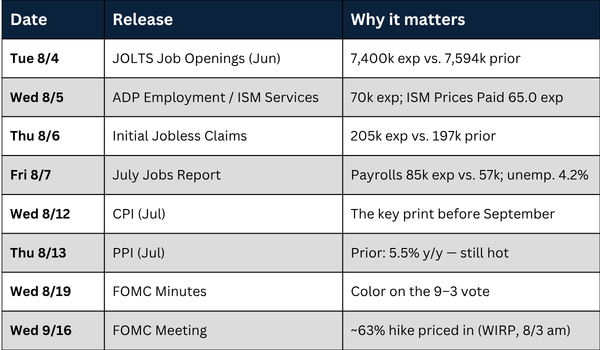
This is a labor-market week, capped by Friday’s July jobs report. Then the real test: August CPI on the 12th — the most important print between now and the September meeting. We wonder if June’s soft report was the best number the Fed was ever going to see.
Luke Fuller, Director
 Luke Fuller is the Director of Capital Markets at Defease With Ease | Thirty Capital, bringing 10+ years of experience in debt structuring, interest rate risk management, and capital markets execution for CRE investors. With expertise in securitization, derivative hedging strategies, and structured finance, he focuses on optimizing debt portfolios and mitigating market risk through advanced financial modeling and analytics. Luke has extensive experience in CMBS, agency, and balance sheet lending, structuring financial instruments, and executing transactions across multiple asset classes. He has advised investors, private equity firms, and REITs on interest rate derivatives, yield curve analysis, loan restructuring, and portfolio risk assessment.